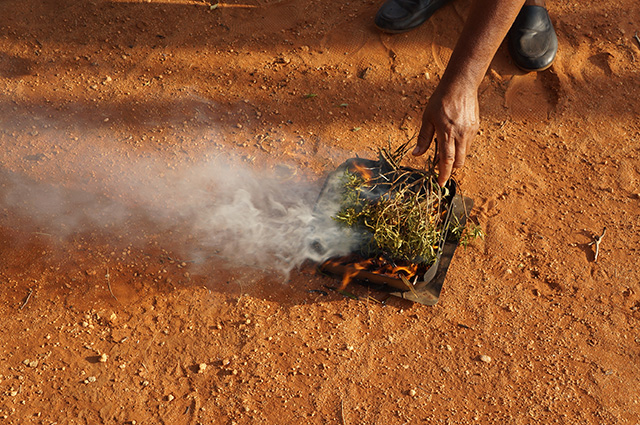
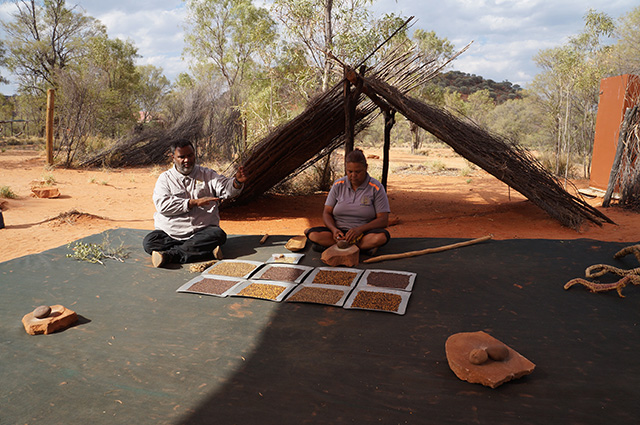
An unusually potent herbal aroma drifted off smouldering barks of weeping emu bush and prickly wattle burning in a flat bowl on the ground in front of us.
“The smoke has a calming effect and reduces anxiety,” explained Peter Abbott, our Indigenous tour guide. “We also burn these leaves and twigs at the end of our ceremonies – the smoking is used to close the porthole into the spirit world.”
As the smoke washed over me, I did feel an unexpected sense of calm – a feeling that I was right where I was meant to be, a rare sense of being centred with the earth.
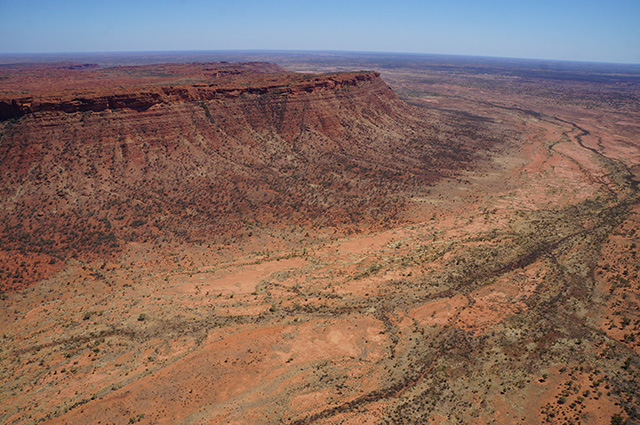
Not that I was overly stressed to begin with. I was in the midst of immersing myself in the magic of the Red Centre and had just landed in Kings Canyon after a 45-minute charter flight from Uluru. As the small aircraft bobbed 5000 feet over the seemingly limitless lunar landscape, I could spot other-worldly salt flats and distant gorges on the horizon.
For a first-time visitor, the journey provides a real perspective on the sheer enormity of the Red Centre.
The Red Centre is an evocative name for Central Australia, the region smack-bang in the middle of the continent. The desert region starts roughly 735 kilometres south of Darwin and, with Alice Springs at its heart, encompasses the West MacDonnell Ranges, Simpson Desert and several national parks. Of course, it’s also home to some of the country’s best known attractions – Kings Canyon and Uluru-Kata Tjuta National Park – which I had come to see. With year-round sunshine (summers are hot and winters are surprisingly mild) and a sparse population, this is the quintessential Australian outback.
An authentic introduction to Indigenous culture
After a quick lunch of camel burger (which I wasn’t unfamiliar with, given my years in the Dubai desert) at a charmingly retro café in outback cattle farm Kings Creek Station, we wound our way through the dusty plains to Karrke, an Aboriginal cultural experience led by Peter and his wife, Christine.
Following a traditional welcome song, the lovely couple offered us a glimpse into Aboriginal culture with a well-practised presentation through various demo stations set up In their sprawling backyard. They talked us through the intricacies of bush medicine (for example, the versatile weeping emu bush is used for healing wounds as well as spiritual cleansing); traditional foods (think ‘bread biscuits’ made of edible tree seeds, baked in an earth oven with hot ash and sand); ancient weapons; and elements of native art and culture.
Peter and Christine’s humble explanations and patient answers to our many questions provided an eye-opening insight into the ancient wisdom of their culture – one that shares a symbiotic relationship with nature.
In Aboriginal culture, the land, plants and animals provide all the sustenance they need – goannas and witchetty grubs are a source of protein, mulga trees provide the wood for spears and utensils, which are glued together with the stronger-than-superglue spinifex resin, and jewellery is crafted from colourful seeds.
What I found most fascinating was that most Aboriginal rituals and traditions are still alive and actively practiced, while in many other ancient cultures, they have been relegated to the annals of barely remembered historic texts.
Feeling appropriately cleansed from the smoking ceremony, we sped on to Kings Canyon, located in the heart of Watarrka National Park on the western end of the majestic Georges Gill Range. Kings Canyon Resort, set just nine kilometres from the national park, is built at the edge of an escarpment to blend into the natural environment. Its strategic location offers stunning views of the canyon and Carmichael’s Crag, the rocky mountain you see in all the iconic images of the canyon.
Kings Canyon hike: an epic Australian outback adventure
Watching the mysterious fissured formation glow and change from rusty brown to vivid orange and almost purple, over very civilised sundowners at the sunset viewing platform, is a captivating experience.
And it really set us up for the Kings Canyon Rim Walk the following morning, which we head off for bright and early at 6am. The six-kilometre loop takes around three to four hours and it gets hotter as the day goes on, but the hardest part is over early – the 100-metre ascent up natural steps hewn out of sandstone at the start of the hike.
You can easily take on the walk yourself but doing it with a guide can greatly enhance the experience. Marcus, a card-carrying outback resident and our guide, peppered the trek with interesting nuggets about how the Aboriginal people have survived and thrived on this harsh land, about the unique local flora and fauna and, well, Priscilla’s Crack – a begging-to-be-Instagrammed V-shaped opening in the canyon wall made famous by iconic film The Adventures of Priscilla, Queen of the Desert.
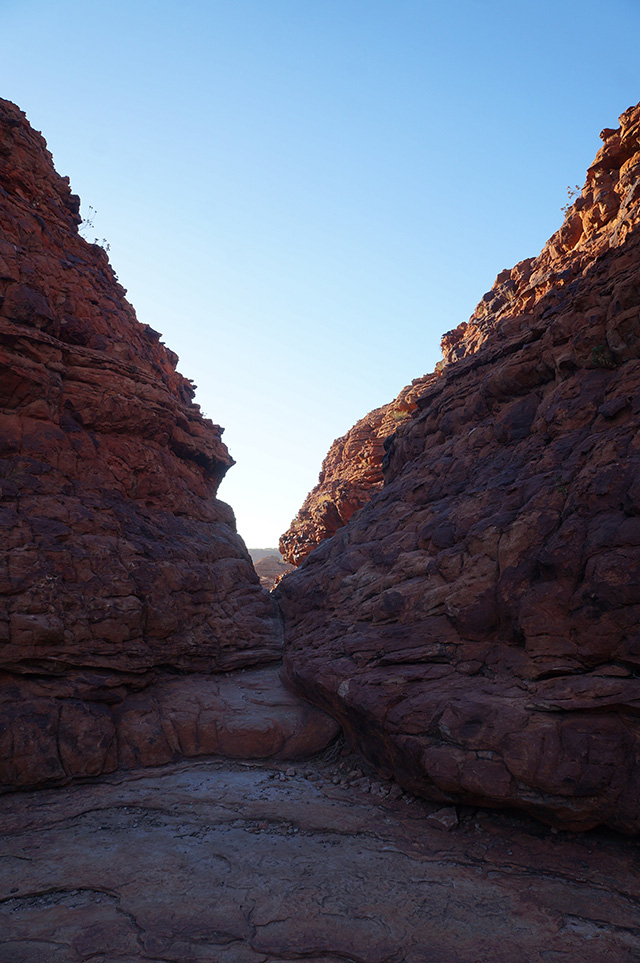
Early in the piece, Marcus stopped our group to explain that “the closest town to where we are at the moment is 1800 kilometres away”. It helped put in perspective the remoteness and epic splendour of the canyon.
This isn’t an obvious sort of beauty. It has to be teased out and appreciated in the context of the millions of years of weathering that has gone into creating the curious ridges, the sheer drops of the canyon walls and the hidden oases within, such as the aptly dubbed Garden of Eden. This lush green watering hole on the canyon floor offered a welcome pit stop about halfway through our walk and made the return home feel easy.
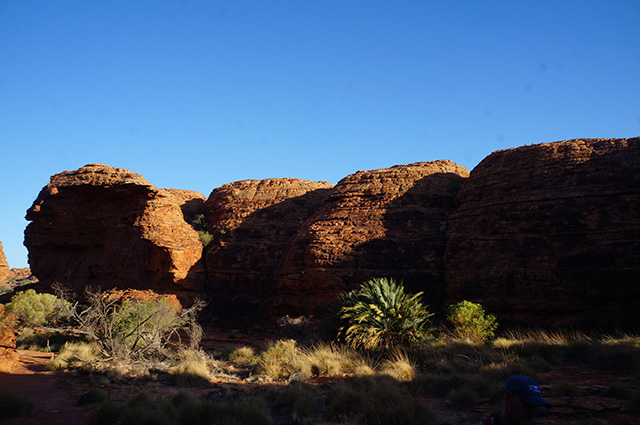
If hiking the canyon is humbling, then seeing it from above is awe-inspiring. A scenic helicopter flight from Kings Creek Station (which is home to the regional airstrip) offers a bird’s-eye view of the mountain ranges. Our friendly pilot made sure we got all the photo-ops we needed, including that of the famous “dingo pups” formation – a large rock that juts out with eight smaller projections alongside. Local Aboriginals refer to it as a mother dingo sitting with her eight puppies.
It is this blurring of lines between what is human, animal and nature, as well as the past, present and future that stood out to me the most on this exploration of culture and the land.
What it’s really like to experience Uluru
Only 48 hours earlier, I’d had another stirring experience when I touched Uluru.
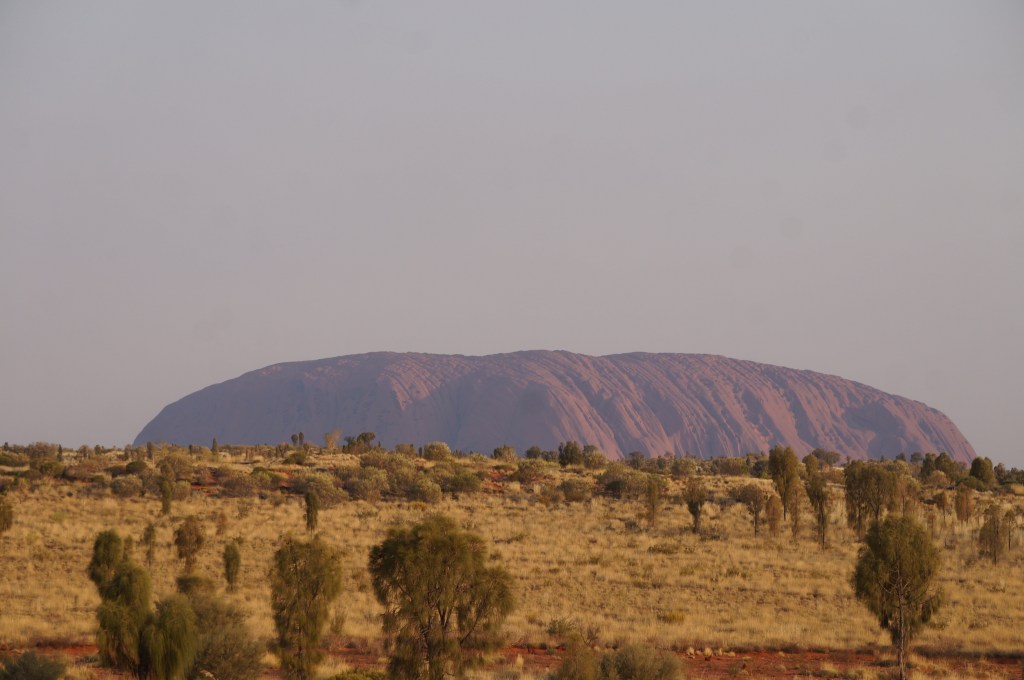
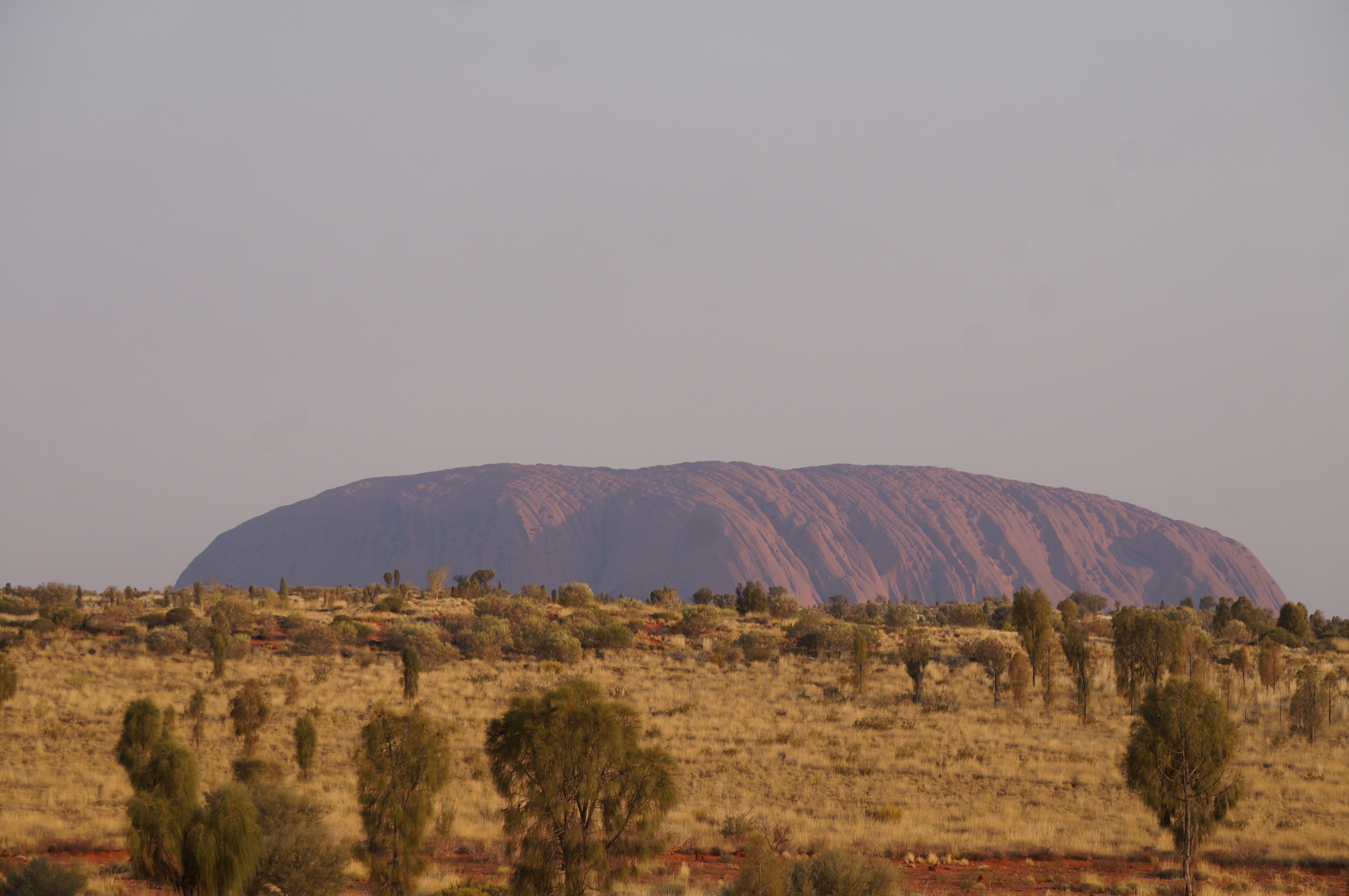
It was impressive to see from afar, of course – like a giant, mythical creature lying in repose. I had witnessed it rise up from the spinifex grassland surrounding it at sunrise and, over a glass of bubbly, I had watched it turn a brilliant red at dusk. But it was only when I walked around its base and put my hands on its undulating surfaces, that I truly sensed its might.
Uluru is essentially a sandstone formation that, over the last 550 million years, has been pushed and tilted up by movement of the earth’s tectonic plates to become the uniquely proportioned structure we see today.
The local Anangu people’s back-story is far more interesting however.
Amidst the rock’s many nooks, caves and watering holes lie millennia of stories and their inherent life lessons. You can see them in the (now faded) cave paintings. And you can find them in the crevices and gashes along its ridged, undulating surface which – when you view them with the right perspective – represent the tracks of the greedy lizard man who fell to his death because of lying and stealing; the marks of the battle Kunia the snake woman fought to defend her nephew from attackers (there’s a moral lesson about family in there) and many more…
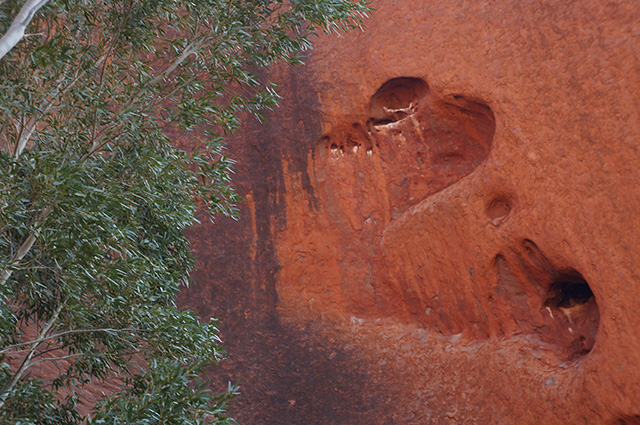
The stories that I learnt were but a distilled fraction of the complex fabric of Creation Time or Tjukurpa, because as visitors, we are only allowed a tiny peek into the hallowed tales.
What wasn’t hard to see however was how this monolith has been a source of shelter and sustenance to its people for centuries – its caves providing a home, the watering holes tucked away in its belly providing fresh water and food. No wonder this maternal figure-like rock, as well as the majestic Kings Canyon, are not only counted among Australia’s greatest natural wonders, but hold a special significance in Aboriginal culture.
By making an effort to understand their mystical power, I came away rewarded with having gained an insight into a culture as vast as the stark land that surrounds it, and a rare opportunity to make a real connection with the earth and its energies.
Need to know: Your guide to visiting Uluru
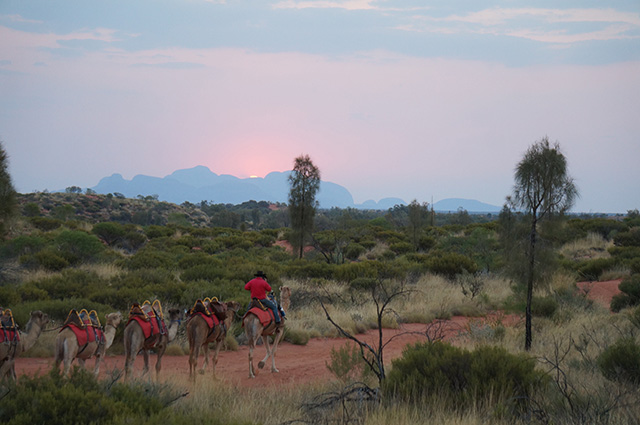
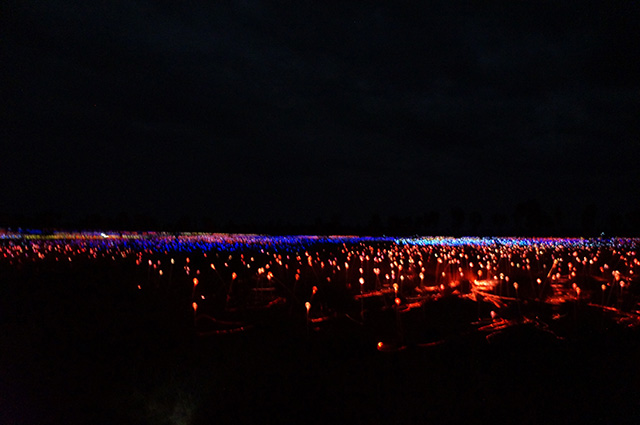
The Ayers Rock/Connellan Airport is located 10 minutes from Yulara, a resort township about 25 kilometres from the Uluru-Kata Tjuta National Park. While no-one is allowed to stay within the national park, Yulara offers accommodation options for various budgets, including five-star hotel Sails in the Desert (also home to the luxurious Red Ochre Spa). Uluru can be visited independently by foot or bike, or with an organised tour. Tours range from camel rides with sunset drinks and canapés to sunrise breakfast tours. The energy of the rock can be felt after dark, too. There are activities available such as an alfresco barbecue dinner overlooking the Field of Light (an immersive light art installation by British artist Bruce Munro) with a side of stargazing led by a resident astronomer.
Important note:
Opening times for national parks, resorts and activities may have changed on account of Covid-19 restrictions, please check respective websites for updates before planning any travel.
A version of this article was previously published in Jetstar Magazine.
 SG Consulting
Leave a comment